


Turning an invasive species into opportunity in the Garhwal Himalayas.
Lantana camara has no natural predator in India. Communities in the Garhwal Himalayas had no way to turn it into dye until Tri-Impact trained them to. That training then grew: the same techniques turned out to work on native plants already part of the region's own tradition, and on food waste already piling up in kitchens and orchards.
Explore the Natural Colour Repository Built with British Council, under the Climate Futures: South Asia programme. Delivered as "Mapping Nature's Palette for Climate-Responsive Artisanal Practices."Two unrelated crises. One overlooked answer sitting between them.
British colonial planters brought Lantana camara to India as an ornamental garden plant more than two hundred years ago. It has no natural predator here, and it has spread through forest and farmland across the Garhwal Himalayas, crowding out native vegetation and raising the fuel load that drives forest fires. A 2020 study found the plant now threatens roughly 40% of India's tiger habitat, a scale hand-clearing and herbicide haven't reversed, because clearing it gives the people doing the clearing nothing back.
The World Bank estimates that textile dyeing and finishing accounts for 17 to 20 percent of industrial water pollution worldwide, and synthetic dyes commonly carry heavy metals that end up in the waterways artisan communities use. That's the industry the same artisan economy depends on for its income.
Tri-Impact's Natural Colours programme sits at the intersection of these two problems, not as a symbolic gesture, but because the plant driving one crisis turned out to be a workable input for addressing the other. Himalayan knotweed, a second invasive species in the same landscape, yields a further natural dye range, and it turned out not to be the only source worth building a training programme around.
A method built to keep running long after the training ends.
Tri-Impact's training in Uttarakhand started with the two invasive species driving the ecological damage described above. It didn't stay there.
Three sources, one training
Lantana camara and Himalayan knotweed, the invasive species named above, teaching artisan communities, largely women, to extract dye from them.
Walnut, wild indigo, Himalayan rhododendron and others already part of the region's own dye tradition, using the same extraction techniques.
Pomegranate rind, onion skin, fruit peel: material otherwise discarded, brought in as a third source rather than left unused.
Artisans now train across all three, not because the invasive-species problem stopped mattering, but because limiting the programme to it would have meant walking past dye sources that were already there.
Matched to material, not to source
Never collect more than 20 to 30 percent of the plant material available at one location, a discipline that applies to the invasive species too. Uprooting responsibly still means not stripping a site bare before seed-bearing parts can be safely removed.
Nine specimens, documented
Young people from Garhwal communities were trained in GPS mapping and used it to build a catalogue of 69 dye-yielding plants across the region. Nine are documented in Tri-Impact's own handbook, six native and three invasive:
Open the handbook. See for yourself what the training actually teaches.
The programme's outputs are documented individually, not folded into a single claim of impact. A bilingual handbook, in English and Hindi, sets out the extraction methods, mordanting process, and sustainable-harvesting protocol above, alongside the field learnings and evidence covered in the next two sections. Three structured learning modules extend the training to artisan communities, students and vocational learners beyond the original cohort: Biodiversity Conservation for Artisanal Communities, Ecosystem Management and Sustainable Harvesting for Natural Dyes, and Circular Economy for Artisans: Turning Waste and Invasive Plants into Economic Value, each available in English and Hindi. A digital catalogue documents the 80-plus dye-yielding plant species mapped across the Garhwal region, with GPS coordinates for each.
Together these make up the Natural Colour Repository, open to download below, so the knowledge built in Garhwal does not stay in Garhwal. Other artisan communities working with the same invasive species elsewhere, and brands exploring natural dye alternatives, can draw on it directly, without Tri-Impact as an intermediary.
Training artisans in a new technique is not the hard part. Getting them into the room is.
The first obstacle was not technical, it was persuading artisans to attend at all: reluctance to spend time on an unfamiliar practice, scepticism about whether it would work, and a fear, reasonable given the stakes, of losing income if it didn't. What moved people was demonstration, not explanation, and early adopters bringing in others once results were visible. None of this comes from a report written after the fact. Tri-Impact's trainers wrote it down as the workshops happened.
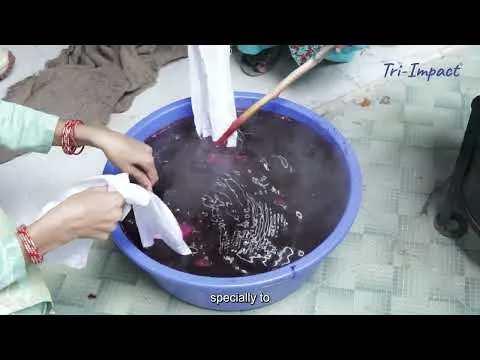
Literacy varied widely across participants, which ruled out written measurements and formulas. Trainers taught dye ratios by comparison instead: a bundle of plant material to a bundle of fabric, rather than a percentage on a page.
"Never collect more than 20 to 30 percent of the plant material available at one location." This is the sustainable-harvesting rule, taught in every workshop, for every species.
Water hardness turned out to differ meaningfully by location, changing colour brightness and uptake even when the recipe was identical, the same instructions gave different colours in different villages, confusing artisans until trainers traced the cause and explained it. Mordants were the hardest single concept to teach: participants questioned why an extra material and an extra step were needed at all, and the explanation that finally worked was visual, trainers held dyed fabric up side by side, with and without proper mordanting, no chemistry lecture needed.
None of this is a complaint about the communities Tri-Impact works with. It's what training looks like when you run it in the field, not when you describe it in a proposal.
From the artisans who did this, and the market that says it's worth doing.
Five short films carry the artisans' own account of learning the technique, in their own words. Watch them before you take Tri-Impact's word for any of the above.
Videos play from YouTube. Nothing loads from YouTube until you press play.


Natural dye is not a craft curiosity elsewhere in India, it is a functioning, exporting industry. Five documented case studies make that case on their own terms: a Jaipur biotech firm now exporting to Turkey, Vietnam, Japan and Sri Lanka; a third-generation dye trading house exporting to the US, Europe, Australia, Mexico and Japan; a Jaipur block-printing manufacturer that has trained more than 4,000 artisans; a Shilp Guru master painter in Jaipur who works with mineral-based natural colours; and a three-decade natural-dye manufacturer in Moradabad. Included here because they answer a question a funder or brand will ask anyway: is there a real market on the other end of this.
Videos play from YouTube. Nothing loads from YouTube until you press play.


An ecological problem, turned into a livelihood, by the people living with it.
Natural Colours was never designed as a standalone project. The dyes it produces feed directly into artisan production in the same producer communities Tri-Impact works with under Livelihood Security, adding an ecological and cultural story to products that would otherwise compete on price alone against machine-made alternatives. The invasive-species removal is not a side effect of the programme, it is the raw material supply for it, which is why the model outlasts a conventional removal campaign: the incentive to keep harvesting Lantana camara is economic, not administrative.
VeraAnchal, a partner platform, offers botanical colour materials to textile buyers. See how Natural Colours connects with Tri-Impact's other initiatives.
Everything above, the repository, the handbook, the modules, the catalogue, is open before you write to us. It exists as documentation, not as a certification or a compliance product, and what you do with it is your own decision. If it holds up to your own review, that's the point at which a conversation is worth having.
"We have personally benefited from this. Our knowledge and understanding have increased. We have learned about the natural things available around us and how we can use them to create our own employment."
Where Natural Colours sits against the Sustainable Development Goals.
 SDG 9: Industry, Innovation and Infrastructure
Native and invasive plant material, and food waste, converted into a documented, replicable production input, mapped across 80-plus species and three extraction methods.
 SDG 12: Responsible Consumption and Production
Natural dye as a documented alternative to a synthetic dye industry the World Bank links to 17-20 percent of industrial water pollution.
 SDG 13: Climate Action
Invasive-species pressure linked to roughly 40% of India's tiger habitat under threat, managed through a livelihoods response.
 SDG 15: Life on Land
Biodiversity stewardship in the Garhwal Himalayas, sustainable-harvesting protocols capped at 20-30 percent of available material per site, applied across native and invasive species alike.
Ask us anything the repository doesn't answer.
The handbook, the modules, the plant catalogue and the artisans' own films cover the how. For funding, partnership or anything specific to your organisation, talk to the team directly.