Start from what works
Identify capability already tested by communities, artisans or businesses under real pressure.


Farmers adjusting planting cycles. Artisans turning invasive plants into dye. Factories rethinking water use under mounting pressure. Real climate responses are already taking shape across India, built by the people closest to the risk. Tri-Impact works alongside them, and alongside the institutions, businesses and researchers who can help those responses go further: tested, strengthened, and shaped into solutions others can adopt.
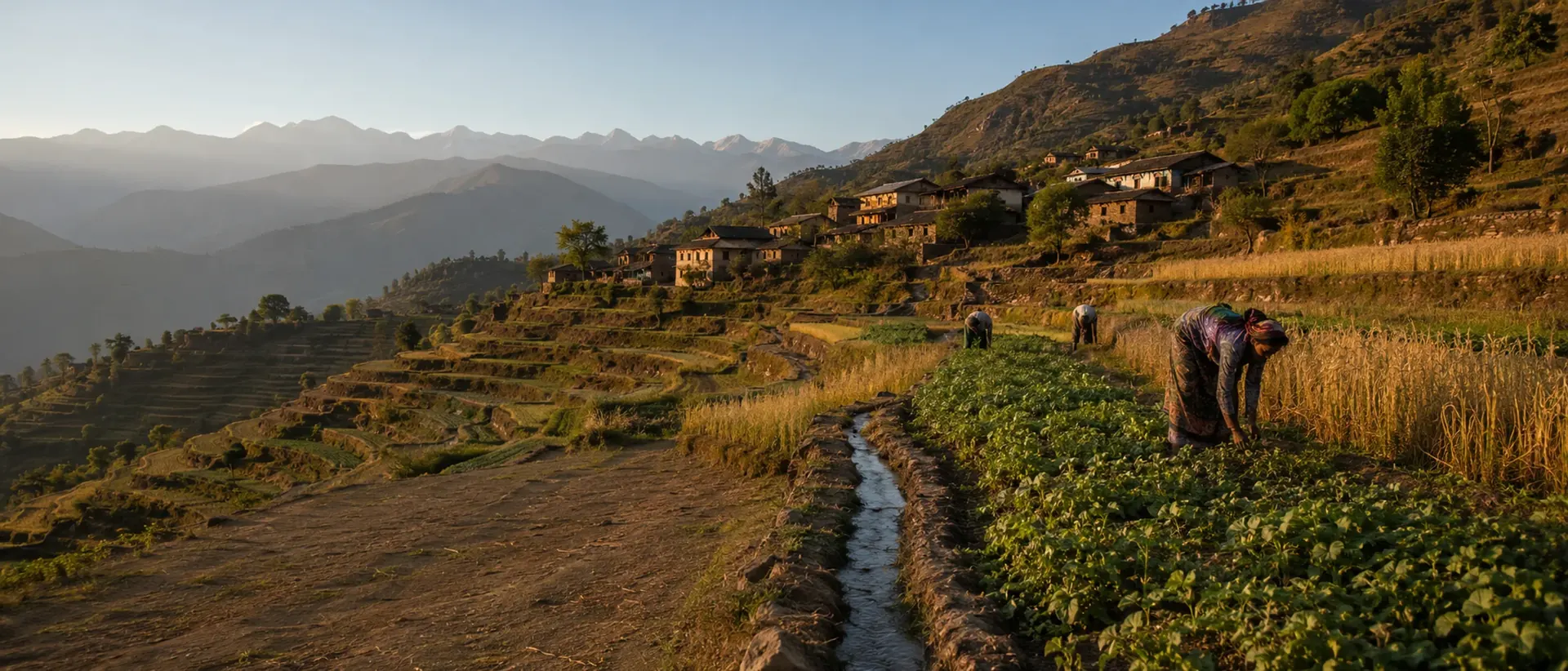
In the first 17 days of the 2024 monsoon, Uttarakhand recorded 1,813 landslides. Across the state, 12,000 natural springs have dried up. In 3,500 villages, farming families have left and not returned.
The same pattern shows up further down the supply chain. In a 2026 survey of garment workers in Tamil Nadu and Delhi-NCR, 87% reported heat-related illness on the job, and manufacturing productivity falls by roughly 4% for every degree Celsius above 27°C (HeatWatch and the Tata Institute of Social Sciences, "Breaking Point: Heat and the Garment Floor"; Somanathan et al., Journal of Political Economy). The same 2026 study projects a 4.5% decline in India's GDP within the decade from heat stress on the garment sector alone, on top of the roughly 34 million jobs the ILO estimates heat stress could cost India by 2030. Brands are aware of the exposure: 94.1% of surveyed apparel and footwear brands sourcing from the region already recognise extreme heat as a moderate-to-significant risk to production. Only 35.3% require suppliers to measure it, and none track it continuously (NYU Stern Center for Business and Human Rights, "Too Hot to Ignore: Extreme Heat in Garment Supply Chains").
The usual response, at both ends, is designed from outside the people carrying the risk. Infrastructure and disaster relief for communities. Generic reporting frameworks for companies. What both miss is what's already visible on the ground, in the field and on the factory floor, to anyone willing to look.
Between 2016 and 2023, Uttarakhand saw a 54% drop in cultivation area and a 44% drop in fruit production. In response, farming communities across Garhwal and Kumaon modified their growing systems, rebuilt water sources using inherited methods, and adapted housing to reduce disaster exposure. None of this was designed in a lab. It was tested against real outcomes, under real pressure. The same discipline is largely missing from supply chains carrying comparable exposure.
The gap isn't knowledge. It's the missing link between what communities and workers already know and the institutions, markets and partners who could carry it further, whether that's a village in Garhwal or a supplier network spanning a dozen countries. Tri-Impact exists to build that link, working directly with the people whose knowledge it starts with.
Tri-Impact's Climate Action work runs on the same method behind every implementation programme Tri-Impact carries out: the Neev Cycle. It starts from what communities, artisans and businesses already do well, builds trust before asking anything of them, shapes solutions together with the people carrying the risk, and documents what holds so it can be carried to the next partner.
Identify capability already tested by communities, artisans or businesses under real pressure.
Shape solutions with those who will use them, not around them or after them.
Turn field practice into evidence, tools and partnerships that another place can use.
In collaboration with Future Generations University.
Tri-Impact's Climate Success Mapping programme works directly with farming communities across 13 Uttarakhand districts to identify, test and strengthen locally developed responses to climate stress, covering agriculture, energy, water, housing and disaster risk reduction.
Using the SEED-SCALE framework, field teams work alongside farming communities across these districts to surface what is already working: multicrop systems holding yield through erratic rainfall, water recharge methods reviving springs given up as dry, biochar production improving soil fertility while sequestering carbon. Each practice is tested and refined together with the community that built it, then structured into a form other communities, and the institutions funding climate resilience, can put to use.
The result is a set of field-tested practices, a methodology for carrying them to the next community, and a team with the relationships and trust already built, ready to start from partnership rather than from zero.
climate adaptation solutions documented
Uttarakhand districts covered
local entrepreneurs implementing documented adaptations
In collaboration with British Council, under the Climate Futures Programme.
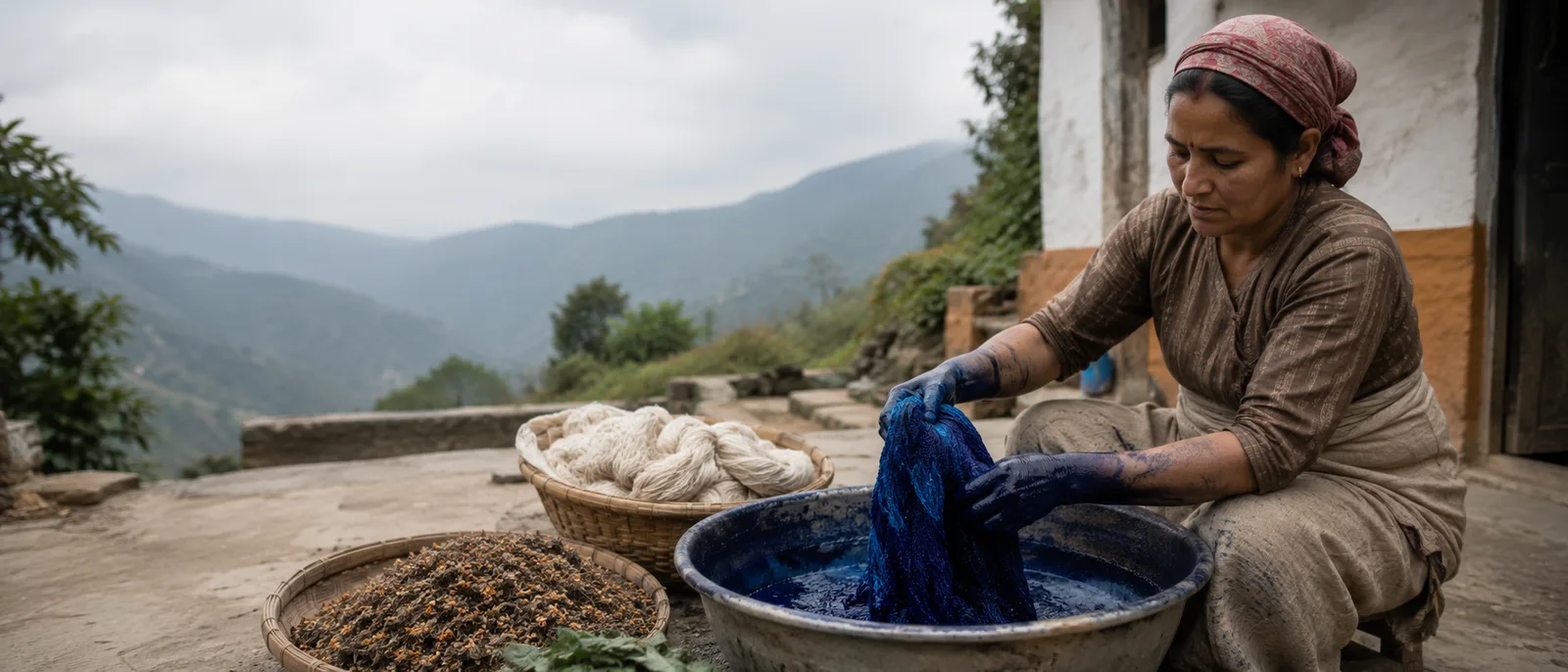
Invasive species like Lantana camara are damaging native ecosystems across Uttarakhand, displacing vegetation and increasing fire risk. Tri-Impact's Natural Colours programme works with artisans, largely women, to convert these invasive plants into natural dyes, free from the heavy metals found in synthetic alternatives.
Built together with artisan communities, the programme has produced a bilingual handbook, a GPS-tagged catalogue of dye-yielding plants, three training modules, and the publicly accessible Natural Colour Repository, a resource other artisan communities and brands can now draw on directly.
Explore the Natural Colour RepositoryBusinesses sourcing from India face direct climate exposure: water stress affecting production regions, extreme weather disrupting supplier networks, and growing pressure to disclose climate risk across operations and supply chains.
The same climate responses Tri-Impact documents at community level, tested farming systems, water recovery methods, natural dye alternatives, sit inside the same production geographies and worker populations that industry sourcing depends on. The exposure businesses are beginning to measure is exposure communities have already been living with and adapting to for years.
Climate Success Mapping and Natural Colours are where that connection is most concrete today: documented practices and dye alternatives that already sit inside the sourcing geographies businesses depend on.
The Climate Action portfolio contributes across the goals because the work is built where climate risk, natural systems, worker livelihoods and business decisions meet.
 SDG 8: Decent Work and Economic Growth
Artisan livelihoods built from nature-responsive production, and climate resilience support for workers in production clusters.
 SDG 9: Industry, Innovation and Infrastructure
Turning an ecological liability into an industrial input, with shared tools that let other communities and businesses replicate what works.
 SDG 13: Climate Action
Community-designed climate solutions, co-built with local and industry partners, extending into supply chains and business operations.
 SDG 15: Life on Land
Invasive species converted into artisan livelihoods, and biodiversity stewardship across the Garhwal Himalayas.
 SDG 17: Partnerships for the Goals
British Council and Future Generations University.
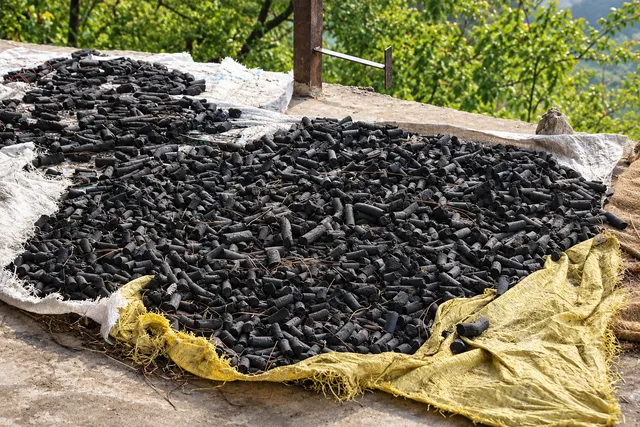
Lantana, pine needles and crop residues, turned into biochar and rural enterprises.
Read more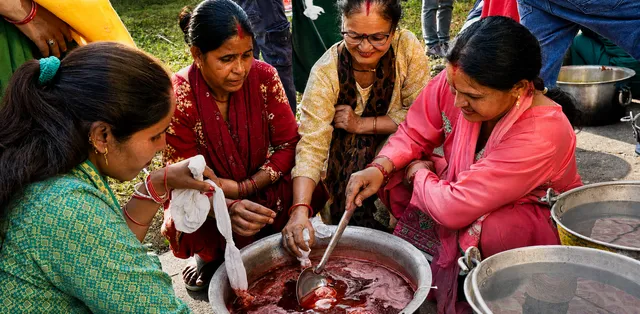
Natural dye from invasive plants, native plants and food waste, made and sold by artisans.
Read more
Livestock dung, turned into compost for the family farm and for sale.
Read moreTri-Impact works with partners who need climate responses that are grounded in field relationships and ready to move beyond concept.
Climate Success Mapping and the Natural Colours programme are both built with the communities they serve, and ready for scale. Organisations funding climate resilience, community-based adaptation, or nature-based solutions will find programmes ready to expand.
Field relationships across 13 Uttarakhand districts support co-research in climate adaptation, ethnobotany and community resilience. The documented dataset of 375+ climate adaptation solutions is accessible for data access and co-authorship with institutional partners.
The Natural Colour Repository provides traceable sourcing data for natural dye inputs. Brands looking for alternatives to synthetic dyes, or supply chain evidence for sustainability reporting, can access the repository directly.
The same field-tested practices behind Climate Success Mapping and Natural Colours sit inside the production geographies and worker populations companies are exposed to. Tri-Impact's field evidence base is a starting point for companies working to understand that exposure.
Climate Action is Schedule VII-aligned under the Companies Act. Tri-Impact is a registered CSR implementing partner under CSR00007814.