Tri-Impact field researcher and a Uttarakhand farmer reviewing a documented climate adaptation practice on-site in the Garhwal Himalayas
CLIMATE SUCCESS MAPPING

Proven climate solutions exist. Success Mapping helps them spread and scale.

While climate risks continue to challenge communities across Uttarakhand, resourceful individuals are pioneering grassroots defenses against extreme weather. Success Mapping surfaces these locally tested solutions, verifies their effectiveness, and helps share them with other communities in need.

In collaboration with Future Generations University
THE CHALLENGE

Rising temperatures, erratic rainfall and natural disasters are already reshaping Uttarakhand.

1,813landslides across the 2024 monsoon, over 6x the 245 recorded in 2022
54%decrease in cultivation area, 2016 to 2023
95,630 hahorticultural land lost over the same period
12,000+natural water sources dried up in the past decade
21,033forest fire incidents, Nov 2023 to Jun 2024, a 74% rise
734villages further depopulated since the 2011 census

Uttarakhand's climate exposure is no longer a projection. The state recorded 1,813 landslides across the 2024 monsoon season, more than six times the 245 recorded in 2022. Between 2016 and 2023, cultivation area fell by 54%, and the Department of Horticulture recorded 95,630 hectares of horticultural land lost.

The water crisis runs alongside it. More than 12,000 natural water sources across the state have dried up over the past decade, and forest fires followed the same trajectory: the Forest Survey of India recorded 21,033 fire incidents between November 2023 and June 2024, a 74% rise on the same period the year before, burning through roughly 1,809 square kilometres of forest cover that communities depend on directly for their livelihoods.

The human consequence is visible in the state's settlement pattern. Of Uttarakhand's 16,793 census villages, 1,048 were already uninhabited at the 2011 census, and the state's own Rural Development and Migration Commission has since documented a further 734 villages depopulated and 565 more with a population decline of 50% or greater.

Sources: Uttarakhand Forest Department and Climate Trends analysis of Department of Horticulture data (cultivation and horticultural land); Center for Ecology Development and Research (natural water sources); Forest Survey of India satellite fire-count data (forest fires); Census of India 2011 and the Uttarakhand Rural Development and Migration Commission (village depopulation). Landslide count and 2022 comparison from contemporaneous reporting of state disaster management data.

WHAT SUCCESS MAPPING IS

Success Mapping identifies, documents, and scales local solutions that work.

Most climate adaptation funding moves toward external interventions, designed and delivered from outside the community carrying the risk. Success Mapping starts from the opposite premise: the solutions already exist.

Success Mapping runs on the same method behind every implementation programme Tri-Impact carries out: the Neev Cycle. Positive Deviance, Appreciative Inquiry and SEED-SCALE are the specific toolkit this programme uses inside that method. Positive Deviance is how it discovers what is already working, Appreciative Inquiry is how it keeps communities leading the process, and SEED-SCALE is the structuring framework that verifies a success and carries it from one household to a wider region. See how the Neev Cycle works

01Positive Deviance

Identification of Local Innovations

Field teams look for practices already outperforming under real pressure, not solutions waiting to be introduced.

02SEED-SCALE

Evidence-Based Documentation

Each success is measured against equity, sustainability, scalability, interdependence and holism, through structured interviews and data.

03KoboToolbox

Digital Mapping and Visualisation

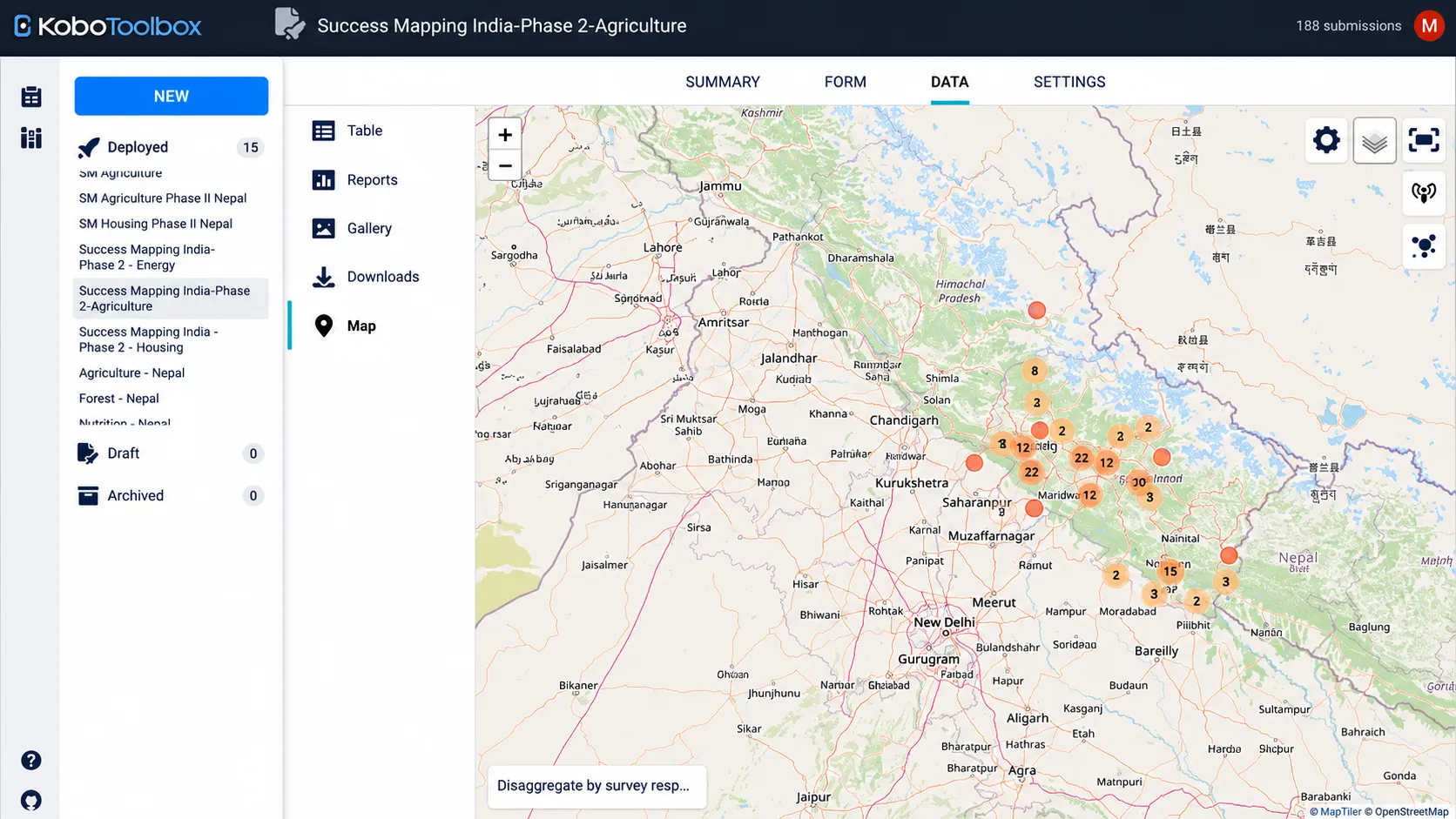
Verified successes are plotted on an interactive map, giving each one a location, an impact record and a scalability assessment.

04Appreciative Inquiry

Knowledge Dissemination

Findings move outward through workshops, online platforms and policy briefs, reaching researchers and officials.

05SEED-SCALE

Scaling Through Partnerships

Community leadership, government support and outside expertise carry proven practices beyond where they originated.

KoboToolbox interactive map showing documented Success Mapping submissions plotted across Uttarakhand districts, with pin clusters indicating the number of verified climate adaptation successes in each location
SUCCESS MAPPING IN ACTION

KoboToolbox visualisation

Success Mapping plots local victories, medicinal farming, polyhouse cultivation, spring revival, on an interactive map built on KoboToolbox. Each pin tells a story: location, impact, and scalability, shared with the U-LEAD network for real-time collaboration.

375+climate adaptation solutions documented
13Uttarakhand districts covered
400+local entrepreneurs implementing documented adaptations
U-LEAD

A collaborative network ecosystem, not a closed research project.

Success Mapping is not a self-contained documentation exercise. It runs inside U-LEAD, Uttarakhand Leadership in Environmental Adaptation and Development, a live WhatsApp network that connects farmers, entrepreneurs, self-help groups, communities, NGOs, government agencies, banks and universities directly.

Members share success stories, exchange best practices and government scheme information, and take part in multi-stakeholder discussions about climate adaptation, ecosystem conservation, sustainable tourism and youth entrepreneurship across Uttarakhand. A farmer in one valley can see, in real time, what worked for a farmer three districts away.

FarmersEntrepreneursSelf-Help GroupsCommunitiesNGOsGovernment AgenciesBanksUniversities
Community leaders and innovators
Recognition, access to resources, and connections to networks beyond their own village.
Communities
Learning, adaptation and economic opportunity grounded in what has already worked nearby.
NGOs, government departments and funders
Data-driven evidence for resource allocation and partnership decisions, verified in the field.
FIELD SUCCESSES

Real people, real change, verified in the field.

Every documented success behind the 375+ figure has a name attached to it. A sample.

"Turning Rain into Savings"

His school faced water shortages and the high cost of buying tanker water. He installed deep recharge tanks and underground storage to collect, filter and store rainwater, eliminating the school's reliance on tankers and improving groundwater levels.

"Saving Forest, Saving Lives"

Forest fires and declining biodiversity threatened both the environment and the livelihoods that depend on it. He rallied the community for tree planting drives and installed fire safety zones with loudspeakers to sound alerts during emergencies.

"Fishing for a Future"

He lost his private-sector job after COVID-19 and faced uncertainty. He took up fish farming with a Rs. 3 lakh MNREGA subsidy, raising 6,000 carp in a pond protected by netting and fencing.

"Juicing Up the Local Economy"

Few income sources were available in his village, and the local economy had stagnated. He started a small business making juice and pickles from local fruit, selling directly at roadside stalls.

"Mushrooms Blooming Through Winter"

He had failed at mushroom farming due to erratic seasons. After ICAR training, he scaled to 22 organic huts using gunny curtains for natural climate control, leasing land to adapt to later winters.

"Harvesting Health with Polyhouses"

He saw untapped demand for organic vegetables but faced growing climate unpredictability. He transitioned to organic farming across three polyhouses with an 80% Horticulture Department subsidy, using drip irrigation.

"Blending Traditional and Modern Technique"

Modern concrete cattle shelters were too cold in winter and too hot in summer. He built a two-storey structure: a ground floor shelter in traditional stone and mud, and a modern RCC upper floor. Cattle health and milk yield improved.

"From Farming Risk to Eco-Tourism"

Drought, unpredictable rain and wildlife damage made her farming increasingly unreliable. She shifted to less water-intensive aromatic farming and built a bamboo eco-homestay for tourists, a stable income independent of climate risk.

"Zero-Waste Construction"

He needed a guest and storage space above his poultry store, on a limited budget. He built it from jute sacks dipped in mud, hardened to function like plywood, on a steel frame. Cost: under Rs. 60,000. It has held up for four years.


Videos play from YouTube. Nothing loads from YouTube until you press play.

Water & Springs

Farming Smarter as the Water Runs Deeper

Water & Springs

Turning Drops into Lifelines: A Water Solution from the Hills

Soil & Agriculture

From Sacred Waste to Soil Health: A Devotional Climate Solution

Soil & Agriculture

Soil, Seasons and Smarter Choices: Farming for the Future

Soil & Agriculture

Waste to Wonder: A Climate Solution in the Making

Soil & Agriculture

From Soil to Solution: Climate Adaptation through Organic Farming

Soil & Agriculture

Organic by Nature: Harsh Aswal's Eco-Friendly Mushroom Revolution

Soil & Agriculture

Turning Waste into Wellness: Akansha Vermicompost's Green Mission

Energy

Powering Progress: A Smarter, Safer Future for Farmers

Energy

Harvesting Sunshine: Surendra Singh's Solar Farming Journey

Livelihoods

From Migration to Regeneration: A Farmer's Journey in the Hills

Livelihoods

Uma's Way: Small Steps Toward a Self-Reliant Future

Livelihoods

Building Climate-Resilient Farms, One Farmer at a Time

Livelihoods

Adesh Kumar's Green Leap from Haridwar

Livelihoods

Veerpur's Wool Revolution: Women Weaving Tradition into Change

Field teams continue to add documented stories to this collection as verification is completed.

WHY THIS SCALES

A documented practice is only useful if it can travel.

A method that works in one valley does not reach the next valley on its own. Success Mapping evaluates every documented practice against five criteria before it is considered ready to travel.

Equity

Does participation and benefit reach across the community, not just one household.

Sustainability

Does the outcome hold environmentally, economically and socially over time.

Scalability

Can the practice be replicated and adapted to a different region.

Interdependence

Does it depend on functioning collaboration between community, government and outside expertise, not one actor alone.

Holism

Does it address environmental, social and economic dimensions together, not one in isolation.

A success that does not meet these criteria stays documented. It does not move forward for scaling.

The methodology, questionnaire design, data collection protocols and training materials built around these criteria are transferable rather than site-specific: any community-based team can be trained to apply the same identification, verification, mapping and dissemination process to a different geography carrying comparable climate pressure.

The digital infrastructure behind it is built the same way. The KoboToolbox platform underlying Success Mapping's field data collection already holds structured records covering agriculture, housing and energy successes, each mapped to a location with an impact and scalability assessment attached. Replicability is not a future ambition. It is built into the methodology, and tested against explicit criteria, from the first success documented.

BE THE SPARK FOR CHANGE

Share your success story. Join the network. Take part.

Join U-LEAD on WhatsApp

Connect directly with farmers, entrepreneurs, NGOs, government agencies and universities working on the same challenges across Uttarakhand.

Request to join

Attend training workshops

Learn the documentation and verification methodology directly from the field team.

Ask about upcoming workshops

Partner with us

Organisations working in climate resilience, community-based adaptation or mountain agriculture can engage directly with a methodology and dataset that is already built and already verified.

contact@tri-impact.org

Your enquiry goes to the Tri-Impact team and is kept as a record, as the Privacy Policy explains.