
Governing Board-Tri-Impact
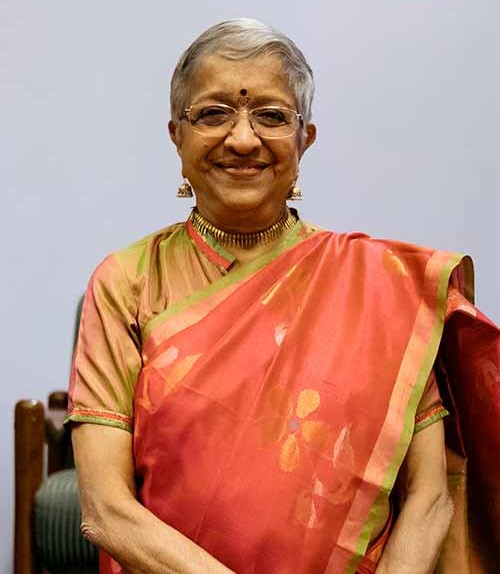
Mrs. Geeta Athreya
Ms. Geeta Athreya is a renowned philanthropist who has devoted her life to social development and human welfare. Currently, an independent Development Consultant, she has helped bring about substantial global reforms while working with government and local bodies in the domains of Health and Education. She has been at the foreground of India’s social development movement and has been an important subsidiary with several Bilateral and Multilateral aid and donor agencies.
As a dynamic speaker and an impressive personality, she has represented in various international events such as the Third World Summit for Children, Greece, 2001; International Union of Health Education Conference, Amsterdam, 1991; communication for Development Conference, Kathmandu, Nepal. Ms. Athreya also has contributed several articles on Health Communication and Child Rights.
Since her association with GoodWeave India Trust, Ms. Athreya has added dimensional value to the organization by bringing more than 30 years of development experience to her role as a board member.

Jagmohan Singh Bangani
Jagmohan Singh Bangani is an acclaimed visual artist from India, whose work bridges traditional
cultural references with contemporary artistic expression. Born in 1977 in a Uttarakhand
Himalayan village, his journey from a modest rural background to international recognition
reflects a deep commitment to artistic excellence, cultural exploration, and mentorship.
He completed his Bachelor of Fine Arts in Drawing and Painting from Dayanand Anglo Vedic
College, Dehradun, and later pursued advanced studies in art. In 2005, he earned a Master’s
degree in Fine Art from the Winchester School of Art at the University of Southampton in the
United Kingdom. Earlier, he also completed postgraduate studies in Painting and Drawing from
the University of Garhwal, where he received a research fellowship from the Lalit Kala
Akademi.
Bangani’s artistic practice explores themes of identity, language, spirituality, and cultural
memory. His works often incorporate scripts, texts, and symbolic visual elements inspired by
diverse languages and philosophical traditions, reflecting his experiences in both India and
abroad. Through layered compositions and vibrant colour palettes, his art reflects the tensions
between rural heritage, urban life, migration, and personal transformation.
Over the course of his career, he has held several solo exhibitions and participated in more than
sixty group exhibitions worldwide, including the Busan Indian Ink Painting Biennale in South
Korea. His works are part of prestigious private and institutional collections in India and
internationally.
His achievements have been recognized through several notable fellowships and awards, including the Senior Fellowship (2025–2027) from the Ministry of Culture, Government of India, the Kalanand All-India Grant Award (2017 and 2023), the Ford Foundation Fellowship (2005–2007), the Junior Fellowship from the Ministry of Culture, and the Uttarakhand State Award (2001).
Beyond his artistic practice, Bangani is deeply committed to nurturing emerging talent. He is the founder of the Bangani Art Foundation (BAF), which mentors and supports young artists and art students, particularly from the Himalayan regions of India where access to artistic training, exposure, and exhibition platforms remains limited. Through workshops, art camps, exhibitions, and the BAF Award, the foundation provides opportunities for emerging artists to showcase their work and receive recognition.
Through initiatives such as the BAF Award exhibition in Dehradun, the foundation identifies and promotes promising artists from Uttarakhand and neighbouring Himalayan states, helping them gain visibility and professional opportunities.
As a Trustee of Tri-Impact Global, Jagmohan Bangani contributes his experience in art, culture, and mentorship to strengthen initiatives that connect creativity, cultural heritage, and sustainable livelihoods. His insights are particularly valuable in advancing programs that support artists and artisans while preserving traditional knowledge and cultural expression.

Mr. Manoj Bhatt
Mr. Manoj Bhatt is a social entrepreneur with over two decades of experience in supply chain sustainability, climate action, child rights, working condition improvement, and building systems change organizations.
Mr. Bhatt holds a master’s degree in International Affairs from the School of International and Public Affairs (SIPA), Columbia University; New York, USA, another Master’s in Political Science from HNB University; Uttaranchal, India, and a certificate in Asset-Based and Citizen Driven Development from Cody International Institute, Canada.
As Country Director of GoodWeave Certification Pvt Limited from 2012 for almost a decade, Mr. Bhatt promoted supply chain sustainability, transparency, and working conditions improvement at the bottom of the global supply chains. His work supported the producers associated with international brands in addressing the risks of Child Labor, Trafficking, and Forced Labor.
Mr. Manoj Bhatt is the founding Managing Trustee of Tri-Impact Global (formerly GoodWeave India Trust). Under his leadership, Tri-Impact Global has led collaborative child-centric education programs for workers’ communities associated with global supply chains. These programs supported the education of around 45,000 at-risk children. Mr. Bhatt also developed and led capacity-building programs for producers on responsible hiring and outsourcing and Participatory Action Learning-based supply chain improvement programs to address human rights risks, including Child Labor, through fostering collaboration.
Mr. Bhatt founded RACHNA in 2007, a network of non-profits working to build green communities by empowering local entrepreneurs and businesses in the Indian Himalayas. He also conceptualized and convened a mountain children’s forum in the south Asian Himalayan areas to empower mountain youth. Mr. Bhatt represented the Central Himalayan region in the Rio+5 Earth Summit – a special session of the UN General Assembly in 1997 organized to review and appraise the implementation of Agenda 21. He created a network of thousands of grassroots elected community leaders, focusing on women leaders to promote learning regarding ecological issues.
Mr. Bhatt managed and led one of the largest non-profits in Indian Himalayas for almost five years, called SBMA, and led its child and women-centric programs in hundreds of villages in partnership with various prestigious global development agencies and the government of India.
Mr. Bhatt has been awarded numerous honors and awards for his exceptional public service and social entrepreneurship, including the Ashoka Innovators for the Public Fellowship Award, Ford Foundation International Fellowship, and Climate Change Leader Award under the British High Commission’s Leadership for Environment and Development program. He was a Future Generations USA Fellow, working with world-class leaders and professionals leading exemplary and high-impact social change in different parts of the world. Mr. Bhatt was also a Fellow of the Rainer Arnhold Fellows Program of the Mulago Foundation, USA. He applied sustainable and scalable change theories in different settings in the USA, India, and Nepal.
Mr. Bhatt was selected as one of the world’s leading social entrepreneurs working in the apparel sector as a Fabric of Change leader. He was also invited to the Ashoka Globalizer program that enables the world’s leading social entrepreneurs to scale their social enterprises and reach new markets. The program links initiatives ready for a global scale to the financial, strategic, and intellectual support they require to go global.
Mr. Bhatt was a member of the Technical Committee of ISEAL Alliance, which represents the global movement of sustainability standards. He speaks at various national and international forums and panels organized by groups such as UNICEF, UNFSS, CRB, and BBC. He also contributes to social and environmental impact awards as a jury member.


